Few places in India carry the spiritual significance of the Triveni Sangam—the sacred confluence of the Ganga, Yamuna and the invisible Saraswati at Prayagraj. For centuries, pilgrims have come here to bathe in its waters, believing that the meeting of these three rivers holds a special sanctity. For us, the visit had a simpler but deeply personal purpose: we wanted to see the Sangam for ourselves and bring back some of its water.
The timing seemed particularly appropriate. The previous day, Riya and I had spent trekking the Parasnath hills, a thoroughly exhausting experience that had left us with little enthusiasm for another strenuous outing. We therefore decided to make the following day a relaxed visit to Prayagraj, exploring the city at an easy pace and, of course, spending some time at the Sangam.
After the exertions of the trek, a day by the rivers sounded like exactly what we needed.
A Fresh Start
We reached Prayagraj from Parasnath at around 3 in the morning by the Rajdhani Express. By then, the previous day’s trek had caught up with us, and there was little left to do except check into our retiring room and get some much-needed sleep. We had booked dormitory beds in advance, which made the late-night arrival considerably easier.
After a good night’s rest, we woke up feeling refreshed and ready to explore Prayagraj. We left our luggage in the station’s cloakroom so that we could spend the day travelling light. Riya had also brought matching outfits for the two of us to wear while exploring the city, which somehow made the day feel like a small occasion in itself.
With the bags safely deposited and the day looking bright, we set out towards the main destination of our trip. We took a shared toto from the station towards the Triveni Sangam. After the exhaustion of Parasnath, it was a welcome change to simply sit back and watch the city come alive as we made our way towards the confluence.
At the Triveni Sangam
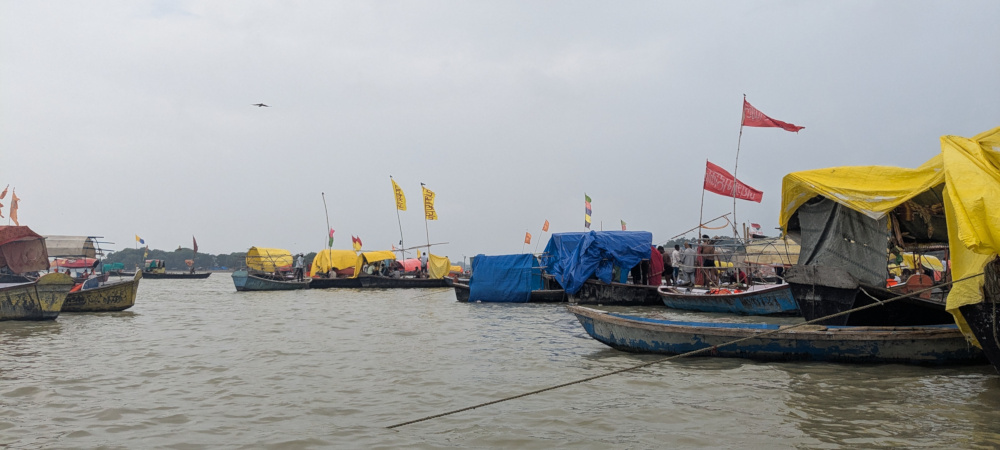
The Triveni Sangam was, of course, the main attraction of our visit to Prayagraj. Once we reached the riverside, we negotiated with one of the boatmen and booked a boat that would take us out to the middle of the confluence. As it turned out, we were rather fortunate with our timing. The boat service had been suspended for the previous three days and had only resumed on the very day we visited. Had we arrived even a day earlier, our plans might have been quite different.
There were already plenty of boats on the river, carrying devotees towards the Sangam. As we moved farther into the river, we noticed an interesting arrangement for bathing. Two boats were positioned parallel to each other and connected with bamboo poles, with wooden planks suspended a few feet below the surface of the water. These floating bathing stations allowed devotees to stand in the river while holding onto the bamboo supports and take a dip safely between the boats.
I decided that a visit to the Sangam would not be complete without taking a bath. I changed into my bathing clothes right there in the boat and took a dip in the river, while Riya decided to skip the bathing part. We did, however, make sure to collect some water from the confluence to take back with us.
The boat ride itself turned out to be quite enjoyable. We took plenty of photographs, and for a while, we even got the opportunity to row the boat ourselves, more for fun than anything else. Our boatman also gave us a quick crash course on the religious significance of the Triveni Sangam, explaining why the meeting of the Ganga, Yamuna and the invisible Saraswati is considered so sacred.
There were a few sights we could not see in their usual form because of the high water level. The famous Hanuman Temple, which is periodically submerged when the river rises, was underwater during our visit. The Allahabad Fort was also partially submerged. Although we missed these sights in their entirety, the unusual sight of the swollen rivers and the activity around the Sangam made the experience no less interesting.
By the time we returned to the shore, we had our photographs, a bottle of Sangam water, and plenty of memories from the boat ride. Despite the few things we could not see, our visit to the Triveni Sangam had turned out to be thoroughly enjoyable.
A Walk to Alopshankari Devi
From the river ghat, we decided to walk to the Alopshankari Devi Temple. The walk itself turned out to be quite pleasant. The route took us through the Parade Ground, and after our time on the river, it was nice to simply stroll through the open surroundings and take in the atmosphere of the city.
Before entering the temple, we bought some sweets and offerings from one of the shops outside. We carried them inside with us and offered them during darshan, as is customary in temples across the country. After being offered to the goddess, our humble offering had, in the usual way, become prasad for us to take back.
The Alopshankari Devi Temple is considered one of the Shakti Peethas, but it is unlike most temples in that there is no conventional idol of the goddess. The shrine has its own distinctive form of worship, making the experience particularly interesting.
We spent some quiet time in the temple grounds after the darshan before setting off again. It was a pleasant pause in our day, but there were still several places left on our itinerary. Soon enough, it was time to move on to our next destination.
Anand Bhavan
Our next stop was Anand Bhavan, the historic residence associated with the Nehru family. After the bustle of the Sangam and the temple, it was a pleasant change of pace. The entire property was beautifully maintained, with the house and its surroundings retaining an atmosphere of an earlier era.
We spent some time going through the museum, looking at the various historical artefacts and exhibits associated with the Nehrus and the freedom movement. There was plenty to see, but we were in no particular hurry. The cool verandah provided a welcome respite from the heat outside, and we spent some leisurely time there simply enjoying the quiet surroundings.
The garden was perhaps the most beautiful part of Anand Bhavan. Well kept and peaceful, it made the place feel less like a museum and more like a living historic estate. After wandering through the exhibits, we took our time in the garden before eventually moving on to the next stop on our itinerary.
From Lunch to Evening
By then, it was time for lunch. We stopped at Sagar Ratna Pure Veg Restaurant, where we had an excellent vegetarian meal. After the filling lunch, we were ready to continue our sightseeing, although at a rather more leisurely pace.
Our next stop was the nearby Bhardwaj Ashram, associated with the mythological sage Rishi Bharadwaj, one of the Saptarishis. After spending some time at the ashram, we walked towards Chandrashekhar Azad Park. The park was beautifully maintained and made for a pleasant walk. We took our time strolling through its paths before reaching the Allahabad Museum.
The museum offered another opportunity to slow down and spend some quiet time looking at historical artefacts and exhibits. We wandered through the galleries without rushing, but as the closing time approached, we had to move on. Khusro Bagh was still on our list, and we hurried there before the day slipped away.
By the time we reached Khusro Bagh, the pace of the day had slowed considerably. The afternoon was quiet, and we spent the remaining daylight wandering through the historic garden complex. After a full day of sightseeing, it was nice to have nowhere in particular to hurry to for a while.
As darkness began to fall, we started walking back towards the railway station. We still had plenty of time before our train, though, and decided to make one last stop. We walked to All Saints' Cathedral, a beautiful old church in the city. Unfortunately, it had already closed for the day, so we could only admire the building from outside.
From there, it was a quiet walk back to the railway station. Our day in Prayagraj had taken us from the sacred waters of the Sangam to temples, historic residences, museums, parks and monuments, all on foot and at an unhurried pace. After the exhaustion of the Parasnath trek the previous day, it had turned out to be exactly the kind of relaxing city tour we had hoped for.
We collected our luggage, boarded the Rajdhani Express, and soon enough, Prayagraj was behind us as we began our journey back to Kolkata.
Street Food in Prayagraj
After the exertions of the previous day’s trek, we had decided that our Prayagraj outing should include one important activity besides sightseeing: eating. We wanted to make the most of the city’s street food, and over the course of the day, we sampled quite a few local favourites.
We started with kachori, the familiar deep-fried, crisp food filled with a spiced mixture and served with potato curry. Next came litti chokha, a Bihar speciality that has found its way into the food culture of neighbouring Uttar Pradesh as well. The litti—roasted balls of dough stuffed with spiced sattu—was served with chokha, a rustic preparation of mashed roasted vegetables. It was hearty and particularly satisfying after all the walking.
We also had golgappa, the crisp, hollow puris filled with spiced mashed potatoes and tangy tamarind water. No street-food outing in this part of the country would feel complete without them. The aloo tikki was another favourite—a crisp, shallow-fried potato patty served with chutneys and spices, making for a wonderfully savoury and tangy snack.
On our way back to the station, we continued our food exploration with an excellent sweetmeat and a variety of milkshakes. Unfortunately, the names of those particular treats have escaped us now, but the taste clearly made enough of an impression to deserve a mention.
By the end of the day, we had managed to combine sightseeing with a fairly serious food trail. Considering that we had come to Prayagraj partly to recover from the previous day’s exhausting trek, indulging in the city’s street food seemed like a perfectly reasonable way to do it.
A Day Well Spent
Our visit to Prayagraj had turned out to be quite different from the usual hurried city tour. We had come primarily for the Triveni Sangam, but the day gradually unfolded into much more—a boat ride on the confluence, a dip in its sacred waters, darshan at Alopshankari Devi, a leisurely afternoon at Anand Bhavan and Khusro Bagh, and visits to museums, parks and historic buildings. In between, there was plenty of walking and, of course, enough street food to keep us going.
After the exhausting Parasnath trek the previous day, we had deliberately kept this day relaxed, and Prayagraj suited that plan perfectly. There was no strenuous climb or fixed agenda to follow. We could simply move from one place to another, stopping whenever we felt like it and enjoying the city at our own pace.
Most importantly, we got what we had come for. We had stood at the Triveni Sangam, taken a dip in the river, and brought back some water from the confluence. By the time we boarded the Rajdhani Express for Kolkata, we were tired again, but it was the pleasant tiredness that comes after a day well spent.
What had begun as a recovery day after a difficult trek had turned into a memorable little journey of its own.
 RSS Feed
Write a comment: