There’s something magical about how journeys in Nagaland unfold — one experience seamlessly flowing into another. I had just completed an unforgettable trek to Dzukou Valley, walking through rolling green hills and vast open stretches that felt both grounding and exhilarating. It set the perfect tone for what came next.
After descending from the valley, I returned to Kigwema and checked back into Dawn Homestay — the same warm and welcoming place where I had stayed before the trek. Coming back felt comforting, almost like returning home after a long day outdoors. I felt energized and ready for more.
On December 10, 2025, the final day of the Hornbill Festival, I made my way to the Naga Heritage Village, Kisama to witness the closing celebrations. There was something special about attending it on the last day — the energy felt heightened, the performances charged, and the atmosphere filled with a sense of grand finale.
From expansive valley landscapes to the rhythmic beats of log drums and bursts of traditional color, the contrast was electric.
If Dzukou was about immersion in nature, Hornbill was about immersion in culture — and ending my trip with its closing day celebrations felt like the perfect finale.
First Impressions: Stepping Into a Living Celebration
I decided to walk to the festival grounds from Kigwema, letting the anticipation build with every step. The December air was crisp, and as I approached the venue, the anticipation grew stronger. By the time I reached the entrance of the Naga Heritage Village, Kisama, the energy was unmistakable.
The entry fee was ₹150, and after purchasing the ticket, I was given a wristband — a small but exciting detail that made it feel like I was about to enter something truly grand.
And grand it was.
The first thing that struck me was the sheer size of the festival. The space felt expansive, almost like a cultural city built for celebration. There were people everywhere — families, groups of friends, solo travelers — not just from across India but also international visitors. It felt like the entire world had gathered in one corner of Nagaland.
The environment was incredibly colorful. Tribal motifs, bamboo installations, and traditional decorations framed the pathways. Some attendees wore striking tribal attire — elaborate headgear adorned with feathers, bead necklaces, shawls with intricate patterns — instantly bringing history and heritage to life.
As I explored further, I noticed the morungs (traditional tribal dormitories) representing different Naga tribes. Each morung had its own architectural style, carvings, and symbolic elements, offering a glimpse into distinct identities within the Naga community. Walking past them felt like traveling through multiple cultures within a single festival ground.
And then there was the food.
The aroma of different varieties of Naga cuisine filled the air — smoked meats, bamboo shoot dishes, local rice preparations, and other exotic foods. Food stalls lined parts of the venue, each offering something unique and deeply rooted in local tradition.
Within minutes of entering, I realized this wasn’t just a festival — it was an immersive cultural experience, vibrant and alive in every direction I turned.
Tribal Dances: Rhythm, Ritual, and Identity
As I entered the festival grounds at the Naga Heritage Village, Kisama, I was immediately drawn to a line-up of tribal performers gathered outside the main pavilion. Dressed in elaborate traditional attire — feathered headgear, layered bead necklaces, patterned shawls, and ceremonial accessories — they stood ready, drums in hand, weapons slung across shoulders. There was a quiet intensity in the air, as if something powerful was about to unfold.
Soon, the celebration moved into the pavilion, and I found a spot in the audience area, surrounded by visitors eagerly waiting for the performances to begin.
The session opened with a roll call of the 17 major tribes of Nagaland. As each tribe’s name was announced, the performers responded with synchronized drum beats and resounding war cries. The pavilion echoed with rhythm and raw energy — it was more than an introduction; it felt like a declaration of presence and pride.
One by one, the 17 tribes performed their traditional dances. (I learned that the order of performances changes each day of the festival, so every day offers a slightly different experience.) What unfolded was a vivid display of diverse cultural expressions and living traditions.
Some dances depicted initiation ceremonies, symbolizing the transition from youth to adulthood. Others portrayed coronation rituals of tribal leaders, complete with dignified processions and symbolic gestures. Several performances recreated martial training and tribal warfare, marked by fierce expressions, synchronized footwork, and the clashing of weapons. In contrast, a few dances celebrated agrarian life, reflecting gratitude for harvests and the rhythms of village life.
Participation varied from tribe to tribe. In some dances, both men and women performed together, moving in coordinated patterns. In others, only the men danced — often enacting warrior traditions — while women stood to the side, observing or contributing through chants and presence.
The range of traditional weapons used in the performances was striking: spears, tribal bladed weapons, wooden clubs, bows and arrows, and even muzzle-loading firearms. These were not displayed casually but carried with ceremonial significance, representing history, protection, and identity. At certain moments, performers fired blank shots from the muzzle loaders, and the sharp cracks echoed through the pavilion, momentarily startling the audience before blending back into the charged atmosphere of the performance. The sound reverberated against the structure, amplifying the dramatic effect of the warrior reenactments.
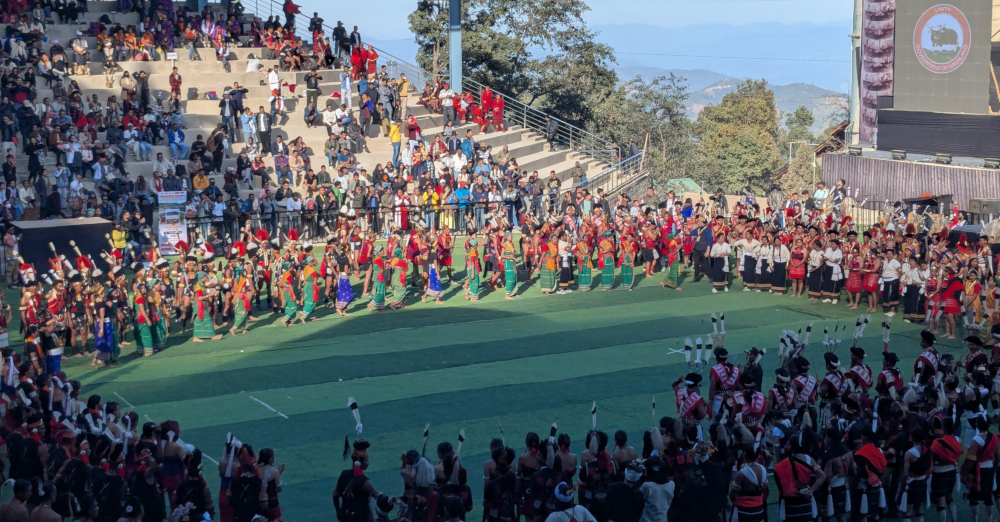
The session concluded with a unity dance, where members of all 17 tribes came together in a shared performance. After witnessing each tribe express its unique heritage, seeing them move collectively on the same stage was powerful — a reminder that while each community carries its distinct traditions, they are bound together within a larger cultural tapestry.
It was not just a performance. It was history, pride, and identity — expressed through rhythm, movement, and voice.
Food at Hornbill: Smoke, Ferment, and Fire
If the dances were a feast for the senses, the food was a feast in the most literal way.
Most of the food was arranged within the morungs — the traditional tribal houses representing different Naga tribes — where each community showcased its own culinary specialties. Walking from one morung to another felt like traveling across kitchens of different cultures. In addition to these, there were also stand-alone food stalls scattered across the grounds, offering both traditional fare and quick bites for visitors.
One of the most popular beverages across the festival was traditional rice beer, locally known as Thutse or Zutho. It was being poured generously, often shared among groups, and felt inseparable from the celebratory atmosphere. Mildly fermented and rustic, it carried a subtle sweetness and an unmistakable sense of tradition.
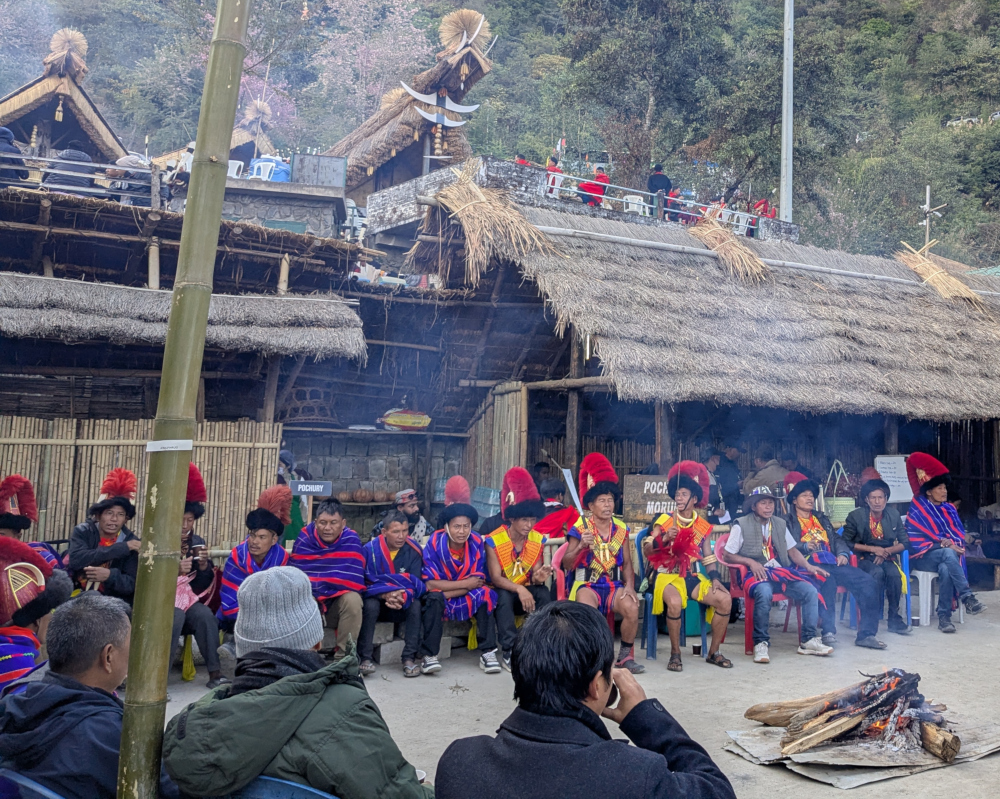
In one of the rice beer outlets I stepped into, there was a large fireplace at the center, around which guests sat with their drinks. The rice beer was served in cups made from bamboo stems, adding an earthy, authentic touch to the experience. Sitting there, holding a bamboo cup warmed slightly by the fire, felt deeply atmospheric — simple yet memorable. It was around that fireplace that I met two retired officers from the Indian Army — one Bengali and one Naga. They seemed to be great friends, sharing stories and laughter with an ease that reflected years of camaraderie. Listening to them talk, in that warm circle around the fire, made the moment feel less like tourism and more like participation.
Rice, unsurprisingly, was central. Various traditional rice dishes were served — usually simple in presentation but paired with bold, smoky, and fermented accompaniments that define Naga cuisine.
Pork dominated the menu in countless forms. The variety was impressive, and some notable dishes included:
- Pork with axone (fermented soybean), strong in aroma and rich in umami
- Pork with bamboo shoot, slightly tangy and earthy
- Pork innards, cooked in robust, spicy gravies
In several places, I saw large cuts of pork being roasted over open flames, slowly turning above wood fires. The sight of meat crackling over embers, fat dripping and smoke rising into the cool December air, added to the rustic atmosphere of the festival.
The signature smokiness present in many preparations stood out immediately — a reflection of traditional preservation and cooking techniques.
Beyond pork, the festival also showcased more uncommon and traditional protein sources. Certain stalls offered dishes made from arthropods, snails, and even dog meat, highlighting food traditions that are deeply embedded in local culture.
Snail, in particular, was completely new to me. When I ordered it at one stall, I quickly realized I had no idea how to eat it out of the shell. The young woman attending the shop noticed my confusion and patiently showed me how to extract the meat properly. She chatted with me the entire time I was there, explaining a little about the dish and smiling warmly as I awkwardly tried to get it right. The kindness felt genuine and endearing — one of those small travel moments that stays with you long after the taste fades.
Among the arthropod dishes, I noticed:
- Grasshopper fries, crisp and lightly seasoned
- Silk worms, prepared as nutrient-rich delicacies
What also stood out was how, in most places, the vendors would ask me how I liked their food. When I told them that I genuinely enjoyed Naga cuisine — the smokiness, the fermented depth, the bold spice — they seemed visibly delighted. Their reactions weren’t performative; they felt proud. That simple exchange turned eating into something more than consumption — it became appreciation.
Moving between morungs and stalls, with smoke rising from cooking fires and the scent of fermented bamboo shoot and axone in the air, I felt that the food at Hornbill is authentic, rooted, and unapologetically traditional.
It is hospitality, identity, and shared pride — served generously and remembered long after the festival ends.
Morungs: Walking Through Living Traditions
One of the most fascinating parts of the festival at the Naga Heritage Village, Kisama was exploring the morungs — the traditional communal houses representing the 17 major tribes of Nagaland. Each morung was more than just a structure; it was a cultural exhibit, a symbolic home, and a storytelling space rolled into one.
The 17 tribes represented were: Angami, Ao, Chakhesang, Chang, Dimasa Kachari, Garo, Khiamniungan, Konyak, Kuki, Lotha, Phom, Pochury, Rengma, Sangtam, Sumi, Yimkhiung and Zeliang.
Each morung featured a replica of traditional tribal housing, built using wood, bamboo, and thatch, reflecting the architectural style unique to that community. The structures were detailed and immersive — from carved wooden entrances to symbolic motifs etched into beams.
Inside and around the morungs, there were displays of common household items, traditional tools, baskets, and implements used in daily life. I noticed arrangements that depicted food storage and preservation methods, offering insight into how communities historically adapted to seasonal cycles and terrain.
Prominently placed in many morungs were large log drums, carved from massive tree trunks. These drums once served as communication tools — used to signal gatherings, warnings, or celebrations. Seeing them up close gave a sense of how central they were to village life.
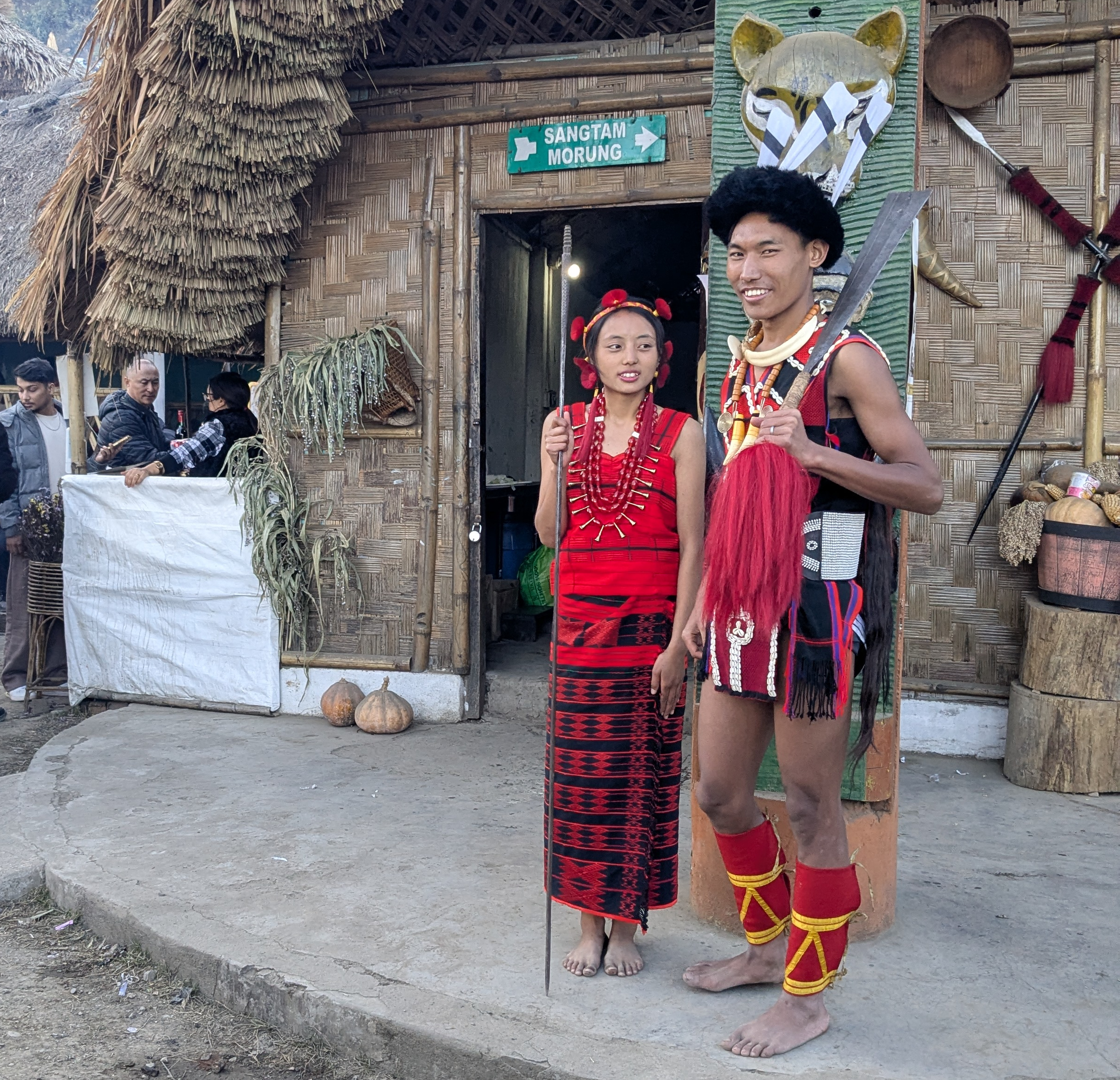
In front of several morungs stood two traditionally dressed representatives — usually one male and one female — adorned in full ceremonial attire. The men often carried traditional weapons such as spears or daos (tribal blades), while the women wore intricate beadwork and woven shawls. They posed proudly for visitors, and in most cases, they welcomed photographs, making it possible to capture a personal memory alongside living culture.
Each morung also had plaques detailing the history, customs, and key features of the respective tribe, allowing visitors to understand the context behind the attire, weapons, architecture, and rituals.
And just like the rest of the festival, food was never far away. Traditional food stalls were set up within each morung, offering tribe-specific dishes — turning every stop into both a cultural and culinary exploration.
Walking through the morungs felt like moving across different worlds within a single festival ground. Each structure carried its own identity, yet together they formed a powerful reminder of the diversity and unity that define Nagaland.
Souvenirs: Taking a Piece of Nagaland Home
Within the festival grounds at the Naga Heritage Village, Kisama, there was a dedicated building for souvenirs, bringing together artisans and vendors from across the state. It felt less like a casual bazaar and more like a curated space showcasing the craftsmanship and material culture of Nagaland.
The variety of souvenirs available was extensive and deeply rooted in tradition.
Among the most striking were the traditional Naga shawls, each woven with distinctive patterns and colors that often signify tribal identity and status. Alongside these were other traditional clothing items, handwoven textiles, beadwork, and accessories — all reflecting meticulous craftsmanship.
There were also edible souvenirs in the form of preserved and packaged local foods — smoked meats, fermented products like axone, dried ingredients, and regional spices — allowing visitors to carry home authentic flavors from the festival.
For those interested in traditional implements, vendors displayed handcrafted tools, knives, and agricultural instruments, made using long-established techniques.
A particularly eye-catching section featured tribal weapons such as spears, daos (traditional blades), wooden clubs etc. Some stalls even offered replica muzzle-loading firearms, crafted as display pieces that reflect historical weaponry used by certain tribes.
Walking through the souvenir shops felt like browsing through tangible expressions of heritage. Each item — whether a shawl, a handcrafted blade, or a packet of smoked produce — represented more than just a purchase.
They were souvenirs in the truest sense: objects carrying stories, identity, and memory long after the festival had ended.
Evening Celebrations: Fire, Music, and Festivity
As the sun began to set over the hills surrounding the Naga Heritage Village, Kisama, the atmosphere shifted once again. The daytime cultural showcases gradually gave way to a more festive, high-energy evening celebration.
The transition was marked dramatically by the lighting of two massive bonfires. As the flames rose into the night sky, they cast a warm glow over the gathering crowd. The crackling firewood, the cold December air, and the growing anticipation created a powerful sense of collective celebration.
The stage came alive with performances by local Naga artists, who brought contemporary interpretations of regional music alongside traditional influences. Their presence felt rooted and authentic — a continuation of the cultural pride displayed earlier in the day.
Alongside them were national and international performers, adding a broader musical dimension to the festival. The diversity of artists reflected how Hornbill is not only a celebration of tribal heritage but also a platform that connects Nagaland to wider cultural currents.
The performances ranged widely — from traditional Naga musical elements and folk-inspired acts to modern bands and high-energy DJ sessions that had the crowd moving well into the evening. What stood out was the seamless blend of old and new: centuries-old traditions along with amplified beats and electronic rhythms.
Watching people from different backgrounds gather around the flames while music pulsed through the grounds, it felt clear that Hornbill is not confined to history. It is evolving, dynamic, and very much alive — carrying tradition forward while embracing contemporary expression.
A Festival Worth Experiencing
Attending the Hornbill Festival on its final day felt like witnessing the culmination of something much larger than a single event. From the powerful tribal dances and the echo of drumbeats in the pavilion, to the smoky aromas drifting from the morungs and the glow of bonfires at night, every part of the day carried a strong sense of identity and pride.
What stood out most was the scale and diversity — 17 tribes, each distinct in language, attire, rituals, and history, yet coming together on one platform. The festival is not a performance staged for visitors; it is a living expression of heritage. The morungs, the food, the weapons, the music — everything felt rooted in authenticity.
If there is one recommendation I would make, it is this: everyone should try to visit the Hornbill Festival at least once. Whether you are interested in history, anthropology, food, music, or simply experiencing something different from mainstream festivals in India, Hornbill offers something rare — immersion.
It is vibrant, intense, educational, and unforgettable.
And for me, it was the perfect way to conclude my time in Nagaland.
 RSS Feed
Write a comment: